
Tuesday, 3 February 2015
Tiberius-Metal Grade 5
Tiberius the metal groove we learned last week, in which i need to practise starts on the tom and moves onto a quarter note groove, usually played quite slowish and heavy like.

Blues rock-Rollin'
Blues Rock-Rollin' is the grade five piece we were looking into today- I found it hard to pick up right off the spot, so its something i'll definitely have to go home and practise. This piece I especially will need to practise as its for an exam later on this year.


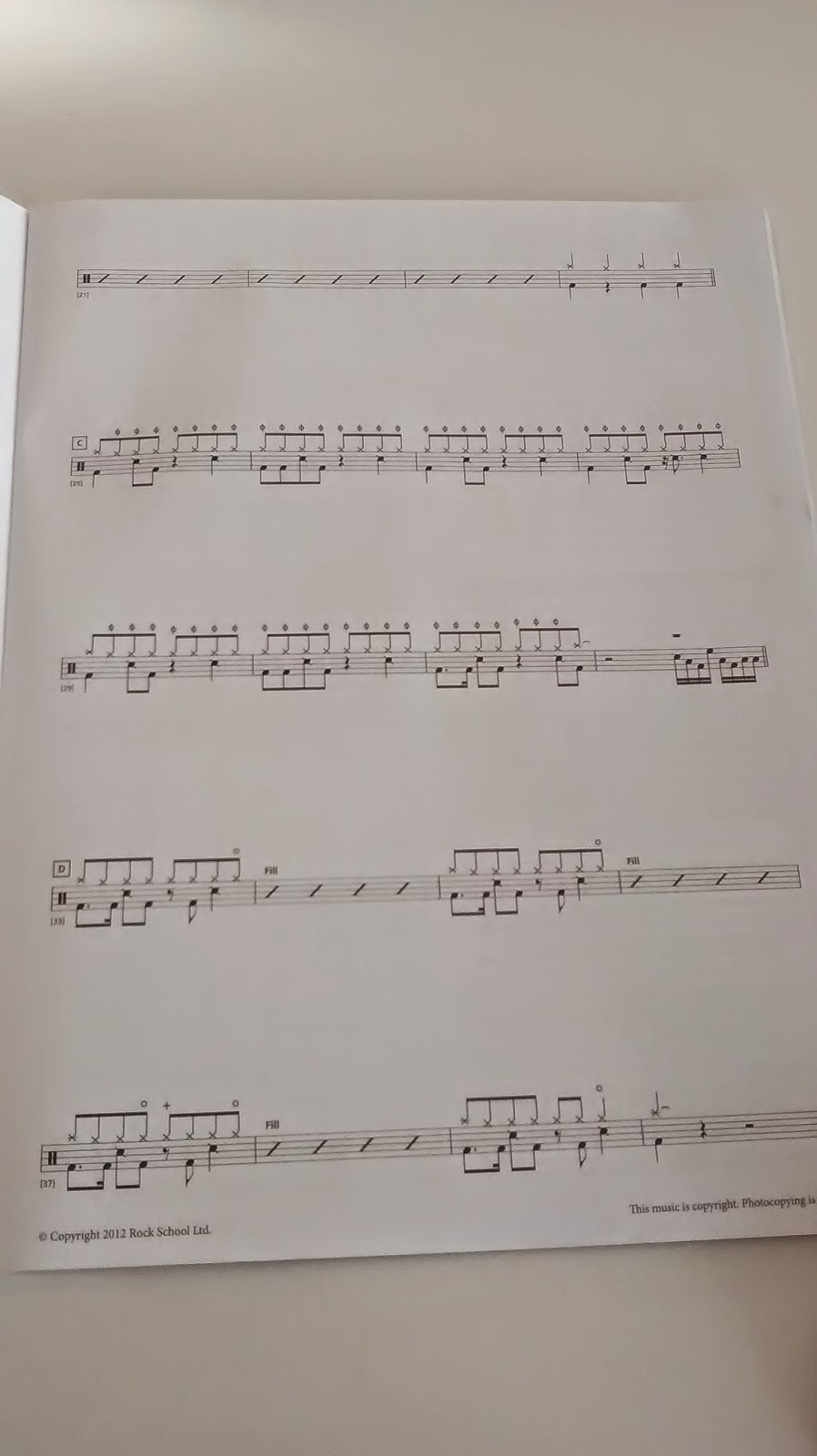
The first two pages (above) of just groove- no time signature changes at any point, however, loads of off-beats and open and closed hi-hat changes making remembering the beat difficult. Something that when you pick up and can remember is very easy. the occasional fill and not necessarily swing patterns but the hi-hat patterns do differ. The first page (top left)- There is a bracket around the second note of the first bar- indicating to only play it once the first time around. Further on down the same page there is a notation saying "To Coda" with a little symbol next to it- that indication marks to go to the coda location on the forth page after you've played the first page the second time around- basically just a short cut that saves writing lengthier amount of tablature. so that indicator, indicates to go to the indication. The pattern right at the bottom play as "R,L,L,R" on the hi-hats.
The next two pages (below) the third page is like the solo page, where for the first good few bars is a developed 16th note snare to tom pattern, then it changes to one par following bass and guitar then into another bar filled with whatever fill you want (so long as it fits).
The fourth page is back to groove, however, there are indicators to go back to the very first page- "D.C.al- Coda" the "C" stands for "cap" meaning to the top, so basically you just go back to the beginning of the song- skipping out any notes in brackets as they've already been played once etc.


Below is a development variation of the 16th note snare fill on page 3 something that also needs practise and developed in anyway.

The first two pages (above) of just groove- no time signature changes at any point, however, loads of off-beats and open and closed hi-hat changes making remembering the beat difficult. Something that when you pick up and can remember is very easy. the occasional fill and not necessarily swing patterns but the hi-hat patterns do differ. The first page (top left)- There is a bracket around the second note of the first bar- indicating to only play it once the first time around. Further on down the same page there is a notation saying "To Coda" with a little symbol next to it- that indication marks to go to the coda location on the forth page after you've played the first page the second time around- basically just a short cut that saves writing lengthier amount of tablature. so that indicator, indicates to go to the indication. The pattern right at the bottom play as "R,L,L,R" on the hi-hats.
The next two pages (below) the third page is like the solo page, where for the first good few bars is a developed 16th note snare to tom pattern, then it changes to one par following bass and guitar then into another bar filled with whatever fill you want (so long as it fits).
The fourth page is back to groove, however, there are indicators to go back to the very first page- "D.C.al- Coda" the "C" stands for "cap" meaning to the top, so basically you just go back to the beginning of the song- skipping out any notes in brackets as they've already been played once etc.
Below is a development variation of the 16th note snare fill on page 3 something that also needs practise and developed in anyway.
Tuesday, 13 January 2015
Odd time Signatures
Lesson we looked into today was on the peculiar odd time signatures - Where we looked at 3/4, 5/4, 5/8, 6/4, 7/4, 7/8, 11/4 and 11/8. Obviously the top number being the amount of the bottom number and the bottom being the fraction so 5-11 over 4 is 5 quarter notes or 7 quarter noters and onto 11 quarter notes- the same applies to 8th notes- just 6 8th notes or 9 8th notes. So technically quarter note bars end up being longer over 8th note bars- this works in that 7/8 ends on count 4 (so just take off an "and") and then 7/4 would just be a bar of 4/4 and a bar of 3/4 put together or 2/4 and 5/4- 11/4 could be a mix of 6/4 and 5/4 or 4/4 and 7/4 or 4/4, 4/4 and 3/4 etc.
Below is the 5/8 Odd time signature-

Next up are the 7/4 and 7/8 odd time signatures plus fills.


11/4 and 11/8 with 3/4, 6/4 and 5/4 added in with fills.


Below is the 5/8 Odd time signature-
Next up are the 7/4 and 7/8 odd time signatures plus fills.
11/4 and 11/8 with 3/4, 6/4 and 5/4 added in with fills.
Tuesday, 6 January 2015
Linear Drumming
Today we were looking at basic linear drumming, basically where none of the hits are played together (however there are some circumstances where this rule is broken).

This is one of the linear grooves we looked into- This is a linear hip hop beat. I feel linear drumming to be a little difficult and something I definitely need to practise at home as well as in college. Some beats were easier than others but others took a little longer to pick up and play confidently.
Due to Linear beats being the way they are, drum fills become quite peculiar if played after a linear beat- However, due to the linear beat usually being structured in 16th notes, its very easy to turn the beat into a fill just by moving the hits from your right hand (or left if left handed) to rather the toms or the snare drum. (as an example, The Linear fill below).

Afterwards we looked at a more complicated Linear pattern, one from the Latin style of drumming, a beat called the Songo. However its not the full Songo, it was broken down a little to be made easier to learn.

The final Linear beat we looked at was called Louisiana Funk- more rudiment based, and the beat was also swung (kind of like horse galloping- two hits at a time, but the first hit is single- so du dada dada etc). Bass and snare hits were in their typical 1 and 3 for bass hits and 2 and 4 for snare, the pattern went L, LR, LR, LR, RL and so on the left hand played on the hi-hat and the right hand played on the ride cymbal- the bass fell on 1 and 3 with the left hand and right hand would hit the snare on 2 and 4 instead of the ride cymbal.

Looking into more technical Linear beats- we look at a Linear groove in half time- were instead of the snare/ Back beat falling on 2 and 4 it falls on 3 instead. There are also more ghost noted snare hits.

This is one of the linear grooves we looked into- This is a linear hip hop beat. I feel linear drumming to be a little difficult and something I definitely need to practise at home as well as in college. Some beats were easier than others but others took a little longer to pick up and play confidently.
Due to Linear beats being the way they are, drum fills become quite peculiar if played after a linear beat- However, due to the linear beat usually being structured in 16th notes, its very easy to turn the beat into a fill just by moving the hits from your right hand (or left if left handed) to rather the toms or the snare drum. (as an example, The Linear fill below).
Afterwards we looked at a more complicated Linear pattern, one from the Latin style of drumming, a beat called the Songo. However its not the full Songo, it was broken down a little to be made easier to learn.
The final Linear beat we looked at was called Louisiana Funk- more rudiment based, and the beat was also swung (kind of like horse galloping- two hits at a time, but the first hit is single- so du dada dada etc). Bass and snare hits were in their typical 1 and 3 for bass hits and 2 and 4 for snare, the pattern went L, LR, LR, LR, RL and so on the left hand played on the hi-hat and the right hand played on the ride cymbal- the bass fell on 1 and 3 with the left hand and right hand would hit the snare on 2 and 4 instead of the ride cymbal.
Looking into more technical Linear beats- we look at a Linear groove in half time- were instead of the snare/ Back beat falling on 2 and 4 it falls on 3 instead. There are also more ghost noted snare hits.
Tuesday, 16 December 2014
Instrumental lessons
over the past few weeks I have looked into and learnt a variety of warm ups, fills and beats from a couple of styles from the music world including; The Nod (hip hop), Cold Pants (funk) and the hammer blow (metal).
Warms consisted of playing 4s (16th notes), then 3s (triplets), 2s (8th notes), then 1s (quarter notes) around the kit so, snare to tom1, tom 2, tom3 and so on. seeing how long can keep it going and gradually building up speed over time.
Another warm up was a triplet based warm up using the snare, and toms 1 and 3, how you would perform the warm up is the first hit is on tom3 (right hand) 2nd hit on snare with the left hand then the 3rd hit on the snare with the right hand then left hit on tom1 the right on snare then left on snare and so on, getting faster then afterwards adding to more hits so on on the toms and one on snare so 3-5-7 hits, then cycling through them, doing 3 hits, then 5 then 7 and back to 3.
Another warm which was taught, actually quite a tricky one at first, but once learnt, quite fun to play- basically its a [pro-active based beat splitting up your limbs so one is playing 3 the other 4 so 4 over 3 beat left hand hitting snare, tom1 then hi hat and the right hand playing snare, and the toms, however at first you hit each thing with hands in unison, then after you have learnt that then you would playing the hands giving separate hits. The final step to add would be adding a bass note after each hit with both hands so right hand left hand, then the bass drum, then after one could 2 bass notes after every two hits.
A couple of the fills we learned incorporated
The Hip hop beat The Nod being the main that we have been looking into, over the past few weeks, simple 4/4 beat with fairly simple fills at the end. A couple of off-beats but nothing to major.
8th and 16th notes with the bass drum and snare moved to weird places.


The hammer blow using a quarter note based beat to give it a heavier sound and therefore more impact in songs. The bass and snare at times are moved to off-beats.

Warms consisted of playing 4s (16th notes), then 3s (triplets), 2s (8th notes), then 1s (quarter notes) around the kit so, snare to tom1, tom 2, tom3 and so on. seeing how long can keep it going and gradually building up speed over time.
Another warm up was a triplet based warm up using the snare, and toms 1 and 3, how you would perform the warm up is the first hit is on tom3 (right hand) 2nd hit on snare with the left hand then the 3rd hit on the snare with the right hand then left hit on tom1 the right on snare then left on snare and so on, getting faster then afterwards adding to more hits so on on the toms and one on snare so 3-5-7 hits, then cycling through them, doing 3 hits, then 5 then 7 and back to 3.
Another warm which was taught, actually quite a tricky one at first, but once learnt, quite fun to play- basically its a [pro-active based beat splitting up your limbs so one is playing 3 the other 4 so 4 over 3 beat left hand hitting snare, tom1 then hi hat and the right hand playing snare, and the toms, however at first you hit each thing with hands in unison, then after you have learnt that then you would playing the hands giving separate hits. The final step to add would be adding a bass note after each hit with both hands so right hand left hand, then the bass drum, then after one could 2 bass notes after every two hits.
A couple of the fills we learned incorporated
The Hip hop beat The Nod being the main that we have been looking into, over the past few weeks, simple 4/4 beat with fairly simple fills at the end. A couple of off-beats but nothing to major.
8th and 16th notes with the bass drum and snare moved to weird places.
The hammer blow using a quarter note based beat to give it a heavier sound and therefore more impact in songs. The bass and snare at times are moved to off-beats.
Tuesday, 9 December 2014
Evaluation of the Induction
Through the past few weeks, my weaknesses that have come to light from rehearsing and performing these variety of genres, mainly consist of my time keeping, counting beats and playing the transitions in the correct places. confidence, not being nervous when performing (which will come naturally) also resulting in my other flaw of speeding up as a result of me being nervous, so hopefully when one flaw is covered another will follow. overall practising more and studying the drummers style and also the genre of music.
Rock - Final week!
Week 6! The final week of induction and we're studying rock, and were I performed 2 songs! Bon Jovi-Livin' on a Prayer and big Guns by Ac/Dc. performance wise I feel that Livin' on a Prayer went far better over Big Guns by Ac/Dc.
Livin' on a Prayer was a little easier to learn and play over Ac/Dc - with Ac/Dc my main problem once more was my timing - going from verse to chorus to verse etc. I'd lose track on how many times I'd played the beat, so I'd forget to change the beat or perform a certain fill. Furthermore, I had rehearsed this less than the other song, which is another reason the other song I performed, I performed better.
Livin' on a Prayer went the best out of all of the performances, just well rehearsed and more practised and I was less nervous and managed to keep the time better and not speed up as much. the fils were okay, and overall I feel it went quite well.
Subscribe to:
Posts (Atom)